Research-based. We haven’t tested these tools ourselves. This guide is built from manufacturer specs, retailer listings and well-established espresso guidance, with sources listed at the end.
Espryo is reader-supported. When you buy through our links, we may earn a commission. Learn more
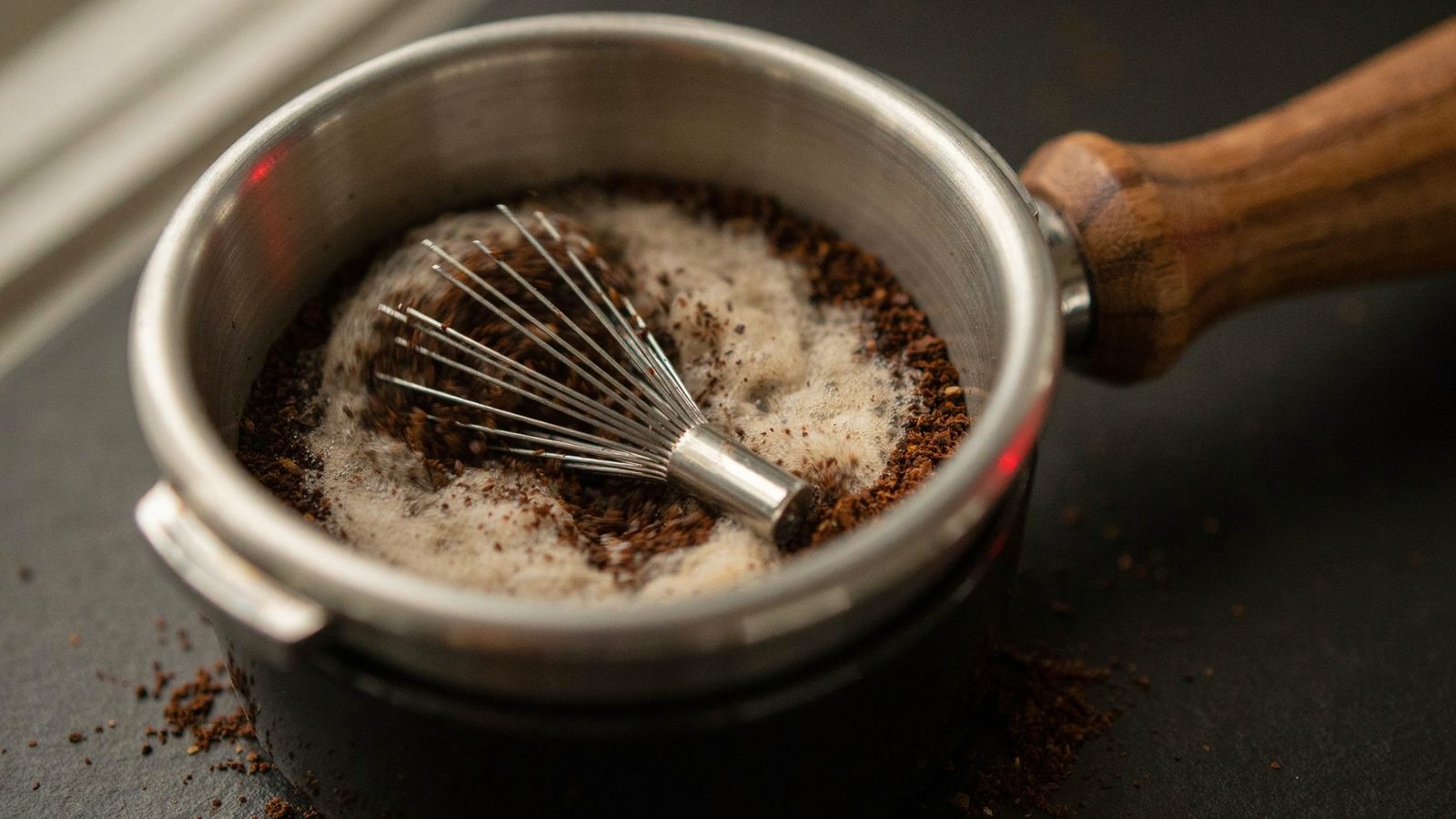
A WDT tool is a handful of very thin needles on a handle. You use it to stir the loose coffee grounds in your portafilter before you tamp. It’s one of the cheapest espresso accessories you can buy, and you can even make one yourself.
Quick answer: If your grinder makes clumps or your shots spurt and run unevenly, a simple needle tool is worth trying. The Normcore WDT Distribution Tool V3 with Stand is a well-rounded pick, with two needle thicknesses in the box and a stand. If you want to spend as little as possible, a cork and a few thin needles do the same basic job. If your grinder already gives fluffy, clump-free grounds and your shots run evenly, you may not need a WDT tool at all.
In this guide
- Keep · Adjust · Upgrade
- What WDT is, and when it helps
- The picks at a glance
- Normcore WDT Distribution Tool V3 with Stand
- MiiCoffee WDT Tool
- Subminimal Flick WDT Tool
- Normcore Needle Distributor Tool V3, Concentric Version
- MHW-3BOMBER YU Series Cyclone WDT Tool, 58 mm (T5849)
- How to choose a WDT tool
- FAQ
Keep · Adjust · Upgrade
| Our verdict | |
|---|---|
| Keep | If your grounds come out fluffy with no clumps and your shots run evenly, keep your current routine. Some setups simply don’t need WDT. |
| Adjust | Try WDT before you buy anything. A wine cork with three thin needles pushed through it, or even a single needle, lets you learn the technique for almost nothing. |
| Upgrade | Buy a tool if WDT helps and you’ll use it daily. A purchased tool gives you evenly spaced needles, a comfortable handle and a stand that keeps the needles straight and out of the way. |
Skip a WDT tool if: you use pressurized (“dual-wall”) baskets. Those baskets build pressure for you, so careful puck prep matters much less. Put the money toward fresh beans or a better grinder first.
What WDT is, and when it helps
WDT stands for Weiss Distribution Technique. It’s named after John Weiss, a home espresso enthusiast who shared the method on online espresso forums in the mid-2000s. Before tamping, you stir the dry grounds in the basket with thin needles. The goal is to break up clumps and spread the coffee into an even bed, from the top of the basket to the bottom.
Why clumps matter. Many home grinders produce clumps, and finer espresso settings can make clumping worse. Clumps pack more densely than the coffee around them. When hot water hits the puck under pressure, it tends to rush through the easiest paths and avoid the dense spots. This is called channeling. If you use a bottomless portafilter, channeling often shows up as spurts or streams coming from one part of the basket instead of an even flow.
What WDT is intended to do. By breaking up clumps and evening out the bed before you tamp, WDT aims to give water fewer easy paths, so the coffee extracts more evenly. How much difference it makes in the cup depends on your grinder, beans and technique. With a grinder that already produces clump-free grounds, the difference may be small or nothing at all. With a clumpy grinder, people often find it more useful.
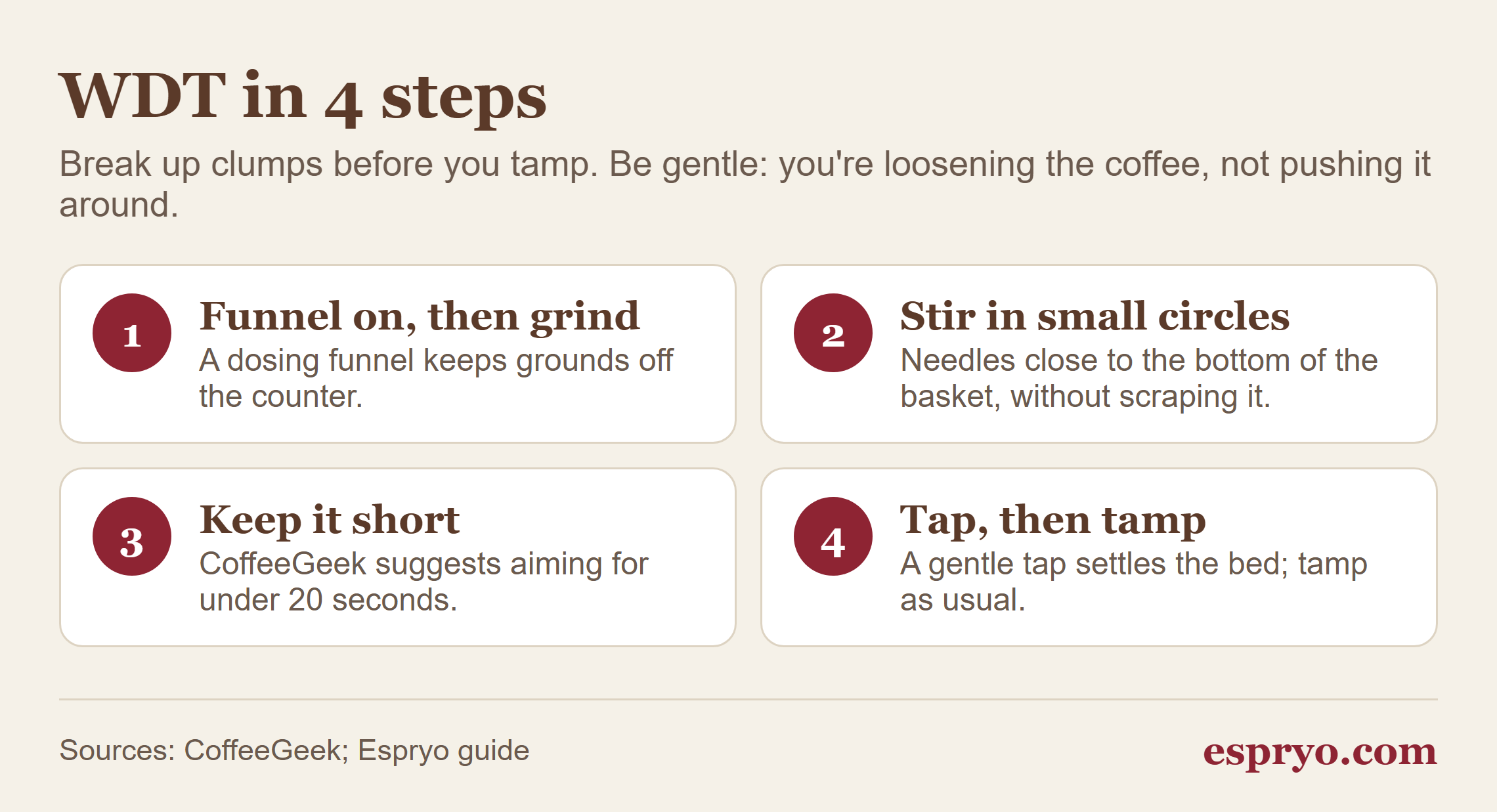
How to do it. Place a dosing funnel on your portafilter, grind into the basket, then stir in small circles with the needles close to the bottom of the basket without scraping it. CoffeeGeek suggests aiming for under 20 seconds. Give the portafilter a gentle tap to settle the grounds, then tamp as usual. Be gentle: too much force, or a tool with thick or looped wires, can push grounds around unevenly instead of loosening them.
The DIY option is real. WDT started with a single dissection needle, and people have used sewing needles, paperclips and toothpicks. A common homemade tool is a wine cork with three evenly spaced thin needles pushed through it; acupuncture needles are a popular choice because they’re very thin. It costs very little and does the same basic job. A bought tool mainly adds comfort, evenly spaced needles and a safe place to store them. Whatever you use, the needles are sharp, so keep the tool somewhere out of children’s reach.
Try WDT before you buy a tool. A wine cork with three thin needles pushed through it lets you learn the technique for almost nothing.
The picks at a glance
| Tool | Needles (as sold) | Needle diameter | Stand or storage | Type | Best for |
|---|---|---|---|---|---|
| Normcore WDT Distribution Tool V3 with Stand | 9 | 0.25 mm and 0.3 mm sets included (9 of each) | Stand included | Classic handheld | Most people starting with WDT |
| MiiCoffee WDT Tool | 9 installed, plus 9 extra | 0.4 mm installed; 0.25 mm extras | Metal stand, plus 3 magnetic points on the handle | Classic handheld | The lowest-cost bought tool |
| Subminimal Flick WDT Tool | Not stated clearly; 6 replacement needles included | Ships with 0.5 mm; 0.35 mm replacements | Aluminum stand with adhesive magnetic mount | Retractable | Keeping the needles protected |
| Normcore Needle Distributor Tool V3, Concentric Version | 14 (51 and 54 mm versions) | 0.25 mm | Magnetic base (per Amazon listing) | Spinning, depth-adjustable, sized to your basket | Breville 54 mm owners who want a guided stir |
| MHW-3BOMBER YU Series Cyclone WDT Tool, 58 mm (T5849) | 14 | 0.25 mm | Sits on the basket; 10 magnets in the base | Press-to-spin, depth-adjustable | 58 mm owners who want a guided stir |
| DIY cork tool | Usually 3 or more | Whatever thin needles you use | None | Homemade | Trying WDT before you buy |
Normcore WDT Distribution Tool V3 with Stand
Best for most people starting with WDT
What it is: A handheld 9-needle WDT tool with a CNC-machined anodized aluminum body and a stand. Normcore includes two sets of 304 stainless steel needles, nine at 0.25 mm and nine at 0.3 mm, so you can swap between them. Normcore lists the total length as 103 mm, with a 50 mm wire length. It comes in several finishes, including a walnut handle version.
Why it’s on the list: It covers the basics well. You get thin needles, a choice of two thicknesses, a stand that protects the needles, and a handle shaped like Normcore’s tamper.
Trade-offs: The needles are always exposed, so the stand matters. Swapping needle sets takes a little patience. Nine needles take a little longer to cover the basket than the 14-needle spinning tools further down this list.
Skip it if: you’d rather have needles that retract into the handle, or you already have a DIY tool that works for you.
MiiCoffee WDT Tool
Best low-cost bought tool
What it is: A handheld tool with nine 0.4 mm stainless steel needles installed and an extra set of nine 0.25 mm needles in the box. MiiCoffee’s Amazon listing says the needles are spread out for efficient stirring. The top of the handle has three magnetic points so you can stick it to a steel espresso machine, and a metal stand is included.
Why it’s on the list: It gives you the main features of pricier tools, a stand, spare needles and two thicknesses, for less money. The 0.4 mm needles are a little stiffer, and you can switch to the 0.25 mm set if you prefer a softer, more flexible stir.
Trade-offs: We couldn’t find specs for this tool on MiiCoffee’s own website, so the details here come from its Amazon listing. The magnets only help if your machine has a steel surface.
Skip it if: you want a retractable design, or a tool with fully published specs from the maker’s own site.
Subminimal Flick WDT Tool
Best for keeping the needles protected
What it is: A retractable WDT tool. One click pushes the needles out, and a flick of the wrist pulls them back into the aluminum body using a magnetic mechanism. Subminimal lists it at 110 x 18 mm and 48 g, with 42 mm stainless steel needles. It ships with 0.5 mm needles installed, which Subminimal says helps them survive shipping without bending, plus thinner 0.35 mm replacement needles that it says most people prefer. The box includes a stand with an adhesive magnetic mount and a hex key for swapping needles.
Why it’s on the list: Exposed needles bend and snag, and they’re sharp. The Flick keeps them inside the body when you’re not using it, which is useful in a busy kitchen.
Trade-offs: You’ll probably want to swap in the 0.35 mm needles right away, which is a small extra step. Subminimal’s page doesn’t clearly state how many needles are fitted at once. A retracting mechanism has more moving parts than a simple fixed tool.
Skip it if: you don’t mind exposed needles on a stand, or you want the most needles possible for faster coverage.
Similar option: Normcore now sells the WDT Tool V4, a twist-to-retract tool that takes up to 14 needles. It’s newer, and Normcore doesn’t list a needle diameter for it yet.
Normcore Needle Distributor Tool V3, Concentric Version
A guided-stir pick sized for 54 mm Breville baskets
What it is: A depth-adjustable spinning distributor that sits on top of your basket. Its 0.25 mm needles stir in fixed circular paths as you turn it, so the pattern is the same every time. Normcore sells it in 51, 54 and 58 mm sizes and says the 51 and 54 mm versions use 14 needles. Depth is stepless: you rotate the handle to match your basket and dose. It’s made from 304 stainless steel, anodized aluminum and brass, and comes with 36 spare 0.25 mm needles and a needle installation tool. The 54 mm Amazon listing names Breville machines including the Barista Express, Barista Pro, Barista Touch and Bambino Plus.
Why it’s on the list: It takes some of the technique out of WDT. Because the tool is sized to the basket and the needles follow set paths, you don’t have to judge how deep or how widely to stir. For Breville 54 mm owners, it’s a sized-to-fit option from a well-known accessory brand.
Trade-offs: It costs several times more than a simple needle tool, takes more space, and only fits one basket size. With more needles, there are more to replace if they bend.
Skip it if: a basic needle tool already works for you, or you might change machines and basket sizes.
MHW-3BOMBER YU Series Cyclone WDT Tool, 58 mm (T5849)
Best for 58 mm owners who want a guided stir
What it is: A 58 mm spinning distributor. You press the handle and a one-way bearing turns 14 needles, which MHW-3BOMBER’s Amazon listing gives as 0.25 mm. An adjustment ring sets the needle depth, and 10 magnets in the base hold it steady on the basket. It’s made from aluminum alloy, SUS304 stainless steel and silicone, and comes with six replacement needles. The listing names Gaggia Classic machines, E61 machines and some 58 mm Breville models as compatible.
Why it’s on the list: Like the Normcore concentric tool, it makes the stir repeatable without much technique.
Trade-offs: It costs more than a basic needle tool. MHW-3BOMBER notes the needles may not reach the very bottom of every basket. This listing is for 58 mm portafilters only; other sizes are sold separately.
Skip it if: you have a 51 or 54 mm machine (check for the right size instead), or a simple needle tool already works for you.
How to choose a WDT tool
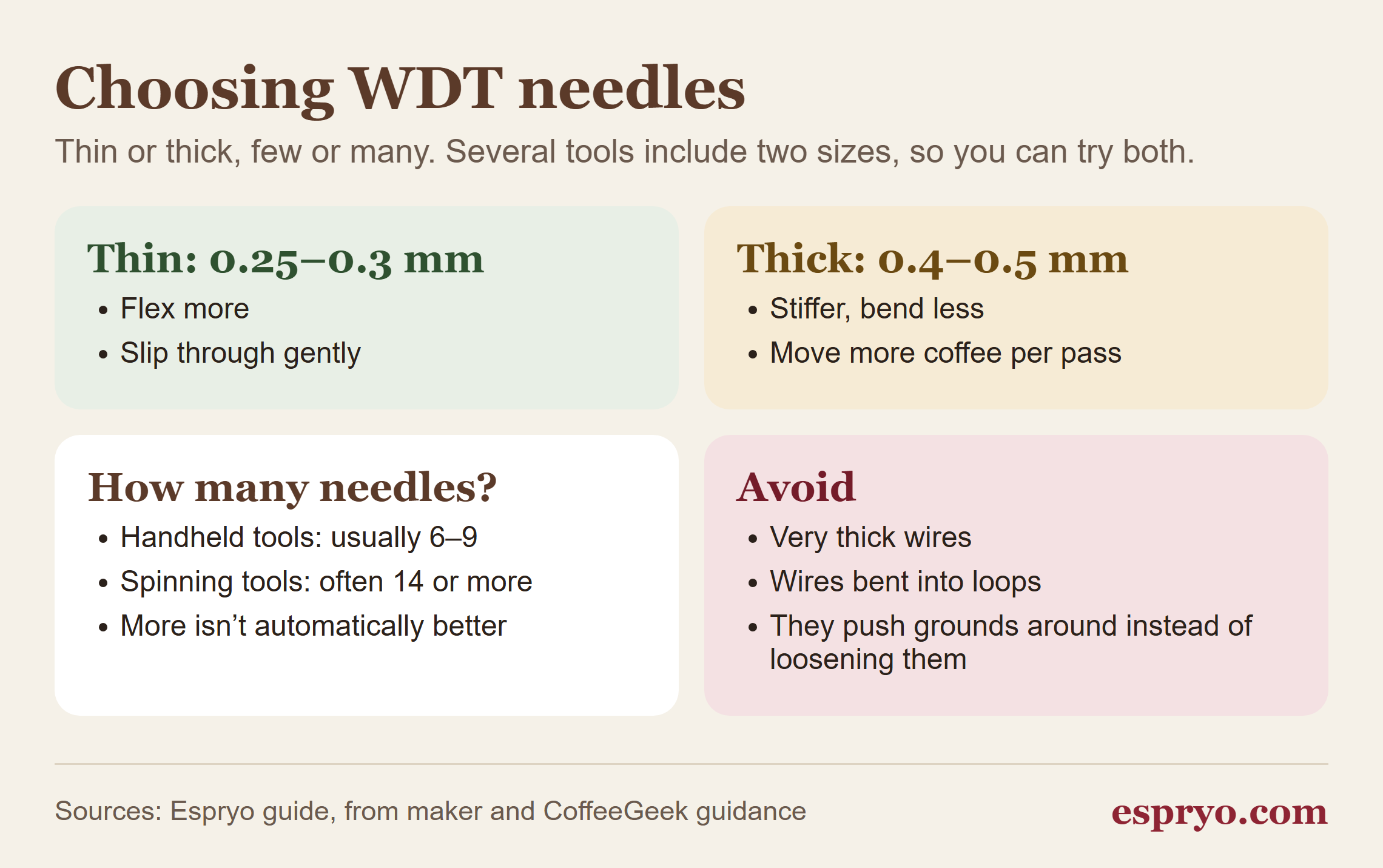
Needle diameter. Thinner needles (about 0.25 to 0.3 mm) flex more and slip through the grounds gently. Thicker needles (0.4 to 0.5 mm) are stiffer and less likely to bend, but they move more coffee with each pass. Several tools here include two sizes, so you can try both. Very thick wires, or wires bent into loops, can leave grooves and push grounds around rather than loosening them.
Not sure which needle size suits you? Several tools here include two sizes, so you can try both.
Needle count. More needles cover the basket faster. Simple handheld tools usually have 6 to 9; spinning tools often have 14 or more. More isn’t automatically better, because what matters is stirring the whole bed gently, all the way down.
Handheld or spinning. A handheld tool is cheap, compact and works with any basket size, but you control the stir. A spinning, depth-adjustable tool is sized to one basket and makes the stir more repeatable, but it costs more and takes more space.
Stand or retractable needles. Exposed needles bend if they’re knocked around. A stand, a magnetic mount or retractable needles keep them straight and keeps the sharp tips out of the way.
Use a dosing funnel. WDT is messy without one. A funnel or dosing collar that sits on your basket keeps grounds from flicking onto the counter while you stir.
FAQ
Does WDT actually make espresso taste better?
It can help, but it isn’t guaranteed. WDT is intended to break up clumps and even out the coffee bed so water flows through the puck more evenly, which can reduce channeling. If your grinder already gives clump-free grounds and your shots run evenly, you may not notice a difference. The best test is your own: try it for a few days with a DIY tool and compare. When stirring doesn’t fix the flavor, the cause is often grind or ratio, which our bitter espresso and sour espresso guides walk through.
What needle size should I choose?
Most current tools use needles between 0.25 and 0.5 mm. Thinner needles are gentler and flex more; thicker ones are sturdier. Subminimal says most of its users prefer 0.35 mm. If you’re unsure, pick a tool that includes two sizes so you can try both.
Can I make my own WDT tool?
Yes. Push three thin needles, such as acupuncture needles, through a wine cork so they’re evenly spaced, and you have a working tool. A single needle also works, though it takes longer. Handle it carefully and store it safely, since the tips are sharp.
Do I still need a distribution tool or leveler if I use WDT?
Not necessarily. WDT already breaks up clumps and spreads the grounds. Some people add a leveler or tap the portafilter to flatten the top before tamping. Start with WDT and a level tamp, and only add tools if your shots still run unevenly.