Research-based: We haven’t tested these steps ourselves. This guide pulls together cleaning guidance from espresso machine makers (Breville and Philips) and specialist espresso retailers (Seattle Coffee Gear and Whole Latte Love), all listed under “Sources” at the end. Your machine’s manual always comes first.
Espryo is reader-supported. When you buy through our links, we may earn a commission. Learn more
In this guide
- Quick answer
- First: cleaning vs. descaling
- What you’ll need
- Step 1: Daily care, every time you make coffee
- Step 2: Weekly backflush, only on machines that allow it
- Step 3: Shower screen and gasket care
- Step 4: Steam wand deep clean
- Step 5: Drip tray and exterior
- Step 6: Super-automatic machines (bean-to-cup)
- Espresso machine cleaning schedule
- Descaling: a separate job
- Troubleshooting
- FAQ
Quick answer
Every time you make coffee, knock out the puck, rinse the portafilter, run a short blank shot through the group head, and wipe and purge the steam wand. About once a week, backflush, but only if your machine has a 3-way solenoid valve or a built-in cleaning cycle. Then soak the removable parts in an espresso machine cleaner every month or so. Descaling is a separate job that removes mineral scale, and you should do it when your manual says to.
Keep · Adjust · Upgrade
- Keep: Use what came in the box first: the cleaning disc or blind basket, any cleaning tablets, the cleaning tool, and your manual’s schedule. Many machines tell you when a cleaning cycle is due.
- Adjust: Purge and wipe the steam wand after every milk drink, while it’s still hot. Seattle Coffee Gear says purging the steam wand “should be done after every milk drink.” Knock out the puck while it’s warm, too.
- Upgrade: A group-head brush to sweep grounds off the gasket and shower screen. An espresso detergent such as Urnex Cafiza for backflushing and soaking. A milk cleaner such as Urnex Rinza for a crusty steam tip.
First: cleaning vs. descaling
These are two different jobs, and mixing them up is the most common mistake.
- Cleaning is the job that deals with coffee oils, grounds and milk. These build up in the group head, shower screen, baskets and steam wand, and they make coffee taste stale or bitter. You use an espresso detergent (cleaning tablets or powder) and water.
- Descaling removes mineral scale from the water side of the machine: the boiler or heater, pump and lines. You use a descaler that runs through the water tank.
Don’t swap the products. Whole Latte Love notes that Cafiza’s label says it “is not a decalcifier and should not be dissolved in a reservoir or put through a boiler.” Seattle Coffee Gear says not to use descaler or vinegar to backflush, because they’re made for scale, not coffee oils. Descaling has its own section further down.
What you’ll need
- Your machine’s manual. It decides the cleaning cycle, the descaler and any model-specific steps.
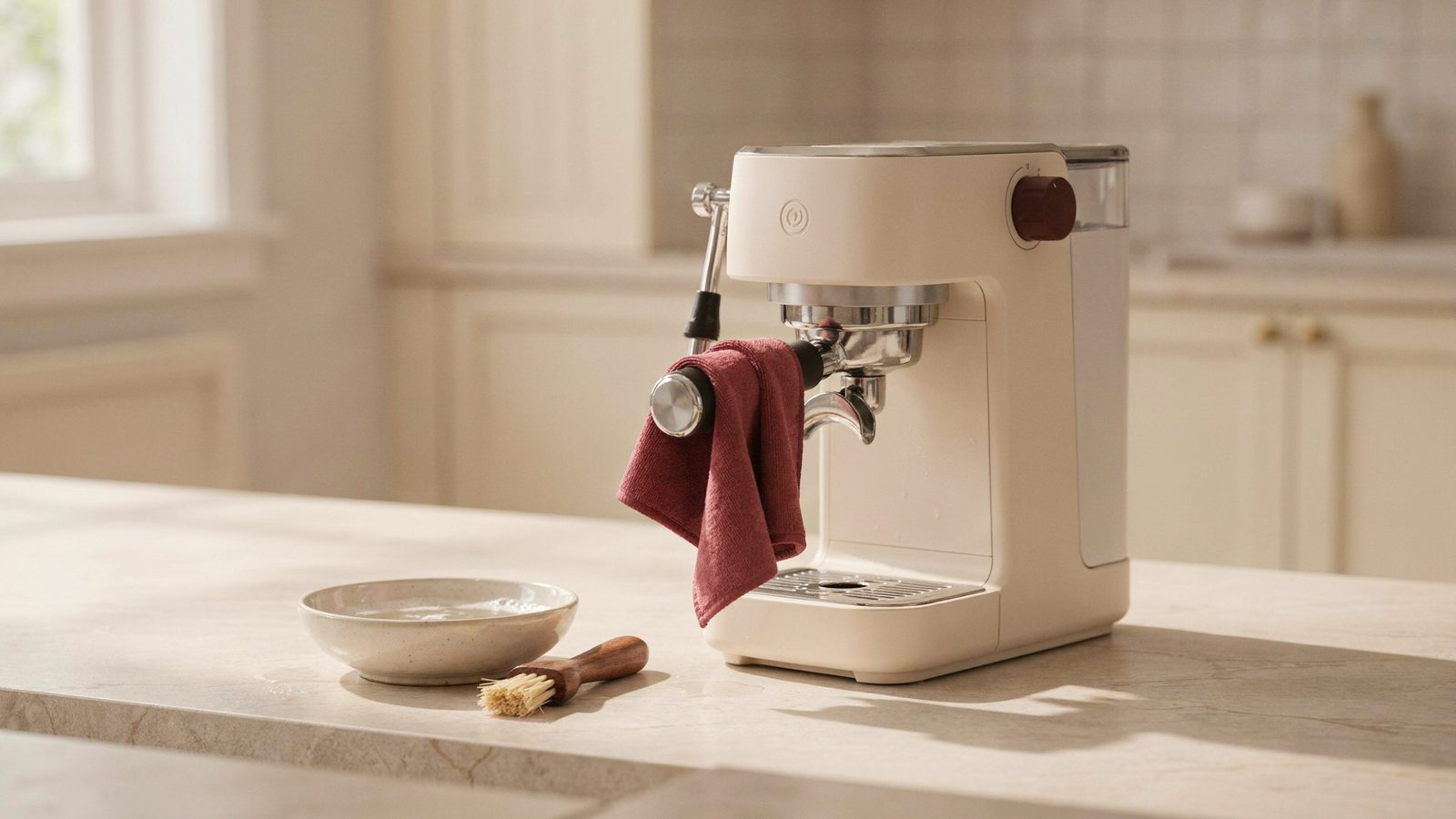
- An espresso machine cleaner. Use the one your manual names. For example, Breville machines with a cleaning cycle use Breville’s cleaning tablets (BEC250). View on Amazon For machines that can be backflushed, specialist retailers widely recommend Urnex Cafiza, which comes as a powder or tablets. View on Amazon
- A blind basket or cleaning disc (a basket or insert with no holes) for backflushing. Many machines include one. Check the manual for your machine’s size.
- A microfiber cloth for the steam wand and the outside of the machine. View on Amazon
- A group-head brush, such as the Pallo Coffee Tool, to sweep grounds off the gasket and shower screen. View on Amazon
- A milk cleaner (optional) for soaking a steam tip with dried-on milk, such as Urnex Rinza. View on Amazon
- A large container for cleaning water, if your manual’s cleaning cycle calls for one.
Before you start: safety
- Watch for scalding parts. The group head, steam wand and hot water outlet run very hot. Keep your hands away while water or steam is flowing, and let the machine cool before you clean parts by hand.
- Switch off and unplug before you take anything apart, such as the shower screen, the brew group or the grinder burrs. Breville’s manual, for example, says to unplug the machine before cleaning, disassembling or assembling it.
- Never put the machine, cord or plug in water or any other liquid.
- Don’t use abrasives on the outside. Seattle Coffee Gear warns against ammonia-based cleaners, bleach, Bar Keepers Friend and other abrasives.
Step 1: Daily care, every time you make coffee
- Knock out the puck while it’s warm. Breville notes the grounds “will be easier and more pliable to remove when they’re warm.” Leaving them sitting lets oil seep into the shower screen.
- Rinse the portafilter and basket. Run them under the faucet for a few seconds, then wipe them dry with a clean towel (Breville).
- Flush the group head. Lock in the empty portafilter and run a short “blank shot” with no coffee to flush out leftover grounds and oils (Breville).
- Brush the group head. Sweep stray grounds off the gasket and shower screen with a group-head brush (Seattle Coffee Gear).
- Wipe and purge the steam wand. Wipe it right after use, while it’s still hot, then release a short burst of steam to clear milk from the tip. Seattle Coffee Gear says to “wipe the steam wand immediately after every use, while it’s still hot.” Breville suggests releasing a little steam into a towel before and after you steam.
- Wipe the outside with a microfiber cloth and hot water (Seattle Coffee Gear).
Step 2: Weekly backflush, only on machines that allow it
What a 3-way solenoid valve is, in plain terms
A 3-way solenoid valve is a small valve at the group head. When a shot ends, it releases the pressure built up above the coffee and vents the leftover water into the drip tray. That release path is what makes backflushing possible. You block the portafilter with a blind basket, the pump pushes water up into the group, and the valve flushes the dirty water out through the drip tray. Seattle Coffee Gear warns that forcing a backflush on a machine without one can damage it.
How to tell if your machine has one (Seattle Coffee Gear):
- At the end of a shot, you hear a brief hiss, and a little water drains into the drip tray after the pump stops.
- A blind basket came in the box.
- The manual says so. This is the only sure answer.
Don’t backflush these (unless your manual says otherwise). Seattle Coffee Gear lists the Breville Bambino and Bambino Plus, “most entry-level DeLonghi machines including the Dedica line,” most entry-level Saeco machines, manual lever machines, and super-automatics, which “have their own cleaning cycles and shouldn’t be backflushed.”
If your machine has a built-in cleaning cycle, use it instead of the generic method below. The Breville Barista Express, for example, runs its own back-flushing cycle with a cleaning disc and tablet. See our Barista Express cleaning guide.
Water-only backflush (about weekly)
Seattle Coffee Gear’s method:
- Put the blind basket in the portafilter and lock it into the group head.
- Run the pump for 10 seconds, then stop for 10 seconds.
- Repeat five times. It takes under two minutes.
Detergent backflush (about monthly, or more often with heavy use)
- Add espresso detergent to the blind basket. Seattle Coffee Gear uses about a quarter teaspoon of Cafiza powder or one Cafiza tablet. Follow the amount on your detergent’s label.
- Lock in the portafilter and run the same cycle: 10 seconds on, 10 seconds off, five times. Soapy, brown water coming out into the drip tray means it’s working (Whole Latte Love).
- Remove the portafilter, throw away the dirty water and rinse the blind basket.
- Run five water-only cycles to rinse out the detergent.
- Pull one shot and throw it away before you make anything to drink (Seattle Coffee Gear).
How often? Advice varies with how much you use the machine. Seattle Coffee Gear’s maintenance schedule suggests a water backflush every few days to a week and a detergent backflush every one to three weeks for home use. Its cleaning guide goes further and recommends a detergent backflush “at least once a week.” If your manual gives an interval, use that. Use only espresso detergent. Seattle Coffee Gear warns that dish soap or vinegar “will make your espresso taste terrible.”
Step 3: Shower screen and gasket care
The shower screen is the metal screen on the underside of the group head that spreads water over the coffee. The gasket (group gasket or seal) is the rubber ring around it that the portafilter presses against to seal.
- Daily: Brush grounds off the screen and gasket, and wipe the group head with a damp cloth.
- Monthly, if your screen is removable: Switch off and unplug the machine and let it cool. Remove the screen as your manual describes. Seattle Coffee Gear soaks it in a Cafiza solution (6 g per 32 oz of hot water) for 15–20 minutes, then scrubs, rinses and reinstalls it. Soak the portafilter and baskets in the same solution, then rinse them well.
- Every 3–6 months: Check the gasket for cracks, flattening or hardening (Seattle Coffee Gear).
- About once a year: Seattle Coffee Gear suggests replacing the gasket and shower screen. Replace the screen sooner if it’s pitted, warped or stained in a way that won’t clean off.
Signs the gasket needs attention: espresso or water leaking around the edge of the portafilter. Breville’s Barista Express manual lists a worn seal as a possible cause of both.
If your machine can’t be backflushed, Seattle Coffee Gear suggests soaking the shower screen in a Cafiza solution monthly for 20 minutes, then scrubbing and reinstalling it.
Step 4: Steam wand deep clean
- If milk has dried inside the tip, unscrew the tip if your machine allows it, and soak it in a milk cleaner. Seattle Coffee Gear says, “For anything that has had milk contact, Rinza is the correct product.”
- To clear blocked holes, use the pin or cleaning tool that came with your machine. For example, Breville’s Barista Express manual says to switch the machine off, let it cool, and clear the holes with the pin on its cleaning tool.
Step 5: Drip tray and exterior
- Weekly, or whenever it’s full: Remove the drip tray and grates, wash them, and dry them thoroughly (Seattle Coffee Gear).
- Exterior: Wipe with a microfiber cloth and hot water. For water spots on chrome, Seattle Coffee Gear suggests an ammonia-free glass cleaner.
Step 6: Super-automatic machines (bean-to-cup)
Super-automatics grind, tamp and brew inside the machine, so cleaning centers on the brew group (the internal unit that brews the coffee) and the milk system. Don’t backflush them. Follow your manual, because each brand handles this differently.
- Removable brew groups (Seattle Coffee Gear names Philips/Saeco and De’Longhi): Philips tells owners to rinse the brew group weekly “using lukewarm water.” It also recommends coffee oil remover tablets (CA6704) monthly for the brew group filter, and greasing the brew group every 2 months. Switch the machine off before you remove the brew group, and let it air-dry before you put it back.
- Brands with a tablet cleaning cycle: Seattle Coffee Gear says Jura machines prompt you to run a tablet cleaning cycle roughly every 180–200 drinks. Our Jura E8 review walks through that model’s cleaning routine.
- Milk systems: Rinse the milk carafe with cold water after milk drinks. If you use milk regularly, run the machine’s milk cleaning program daily (Seattle Coffee Gear).
- Grounds container and drip tray: Empty and rinse them weekly to prevent mold and odor (Seattle Coffee Gear).
- Use your brand’s products. Seattle Coffee Gear’s advice: “Always use the cleaning method and products your specific brand recommends.”
Own a De’Longhi Magnifica Evo? See our Magnifica Evo descaling guide for the descaling side.
Espresso machine cleaning schedule
| When | Task | Machines |
|---|---|---|
| Daily (every use) | Knock out the puck, rinse the portafilter, run a blank shot, brush the group head | Semi-automatics |
| Daily (every milk drink) | Wipe the steam wand while hot, then purge | Any machine with a steam wand |
| Daily | Run the milk cleaning program and rinse the carafe | Super-automatics with milk systems, if you use milk |
| Weekly | Water-only backflush | Only machines with a 3-way solenoid valve |
| Weekly | Rinse the brew group (if removable); empty the grounds bin and drip tray | Super-automatics (Philips says weekly) |
| Weekly | Wash the drip tray and grates | All |
| Monthly | Detergent backflush, then a water rinse and a discarded shot | Only machines with a 3-way solenoid valve |
| Monthly | Soak the shower screen, baskets and portafilter in espresso cleaner; soak the steam tip in milk cleaner | Most semi-automatics |
| Every 3–6 months | Inspect the gasket | Semi-automatics |
| Yearly | Replace the gasket and shower screen | Semi-automatics |
| As prompted | Built-in cleaning cycle, or descaling | Any machine with alerts. Follow the manual |
Descaling: a separate job
Descaling removes mineral scale, not coffee oil, and it’s handled differently from machine to machine. Seattle Coffee Gear says “descaling is occasional and depends on your machine and water.” It suggests about every 3–6 months, more often with hard water or if flow slows. Our advice is simple: descale when your manual or your machine’s alert says to, with the descaler your manual specifies. Seattle Coffee Gear also notes that some manufacturers specify their own descaler, and that using a different product can void the warranty. For machines with a boiler, Seattle Coffee Gear says a professional is the safer choice when the boiler needs draining.
Step-by-step guides:
- How to descale a Breville espresso machine
- De’Longhi Magnifica Evo descaling guide
- How to descale a De’Longhi espresso machine
- Best descaler for espresso machines
Troubleshooting
- Espresso runs out too fast, or around the edge of the portafilter. A blocked filter basket or a worn gasket can cause this. Breville’s Barista Express manual suggests clearing the basket holes with the cleaning pin, or soaking the basket and portafilter in a dissolved cleaning tablet for about 20 minutes. A leaking gasket needs replacing.
- Espresso tastes stale or bitter even with fresh beans. Old coffee oils can flavor later shots (Whole Latte Love). Backflush with detergent if your machine allows it, or soak the shower screen and baskets.
- Soapy taste after backflushing. Run more water-only backflush cycles and throw away a shot before drinking (Seattle Coffee Gear).
- Weak steam or slow flow that cleaning doesn’t fix. That may be scale. See Descaling: a separate job.
FAQ
Can I backflush any espresso machine?
No. Only machines with a 3-way solenoid valve, or those whose manual describes a back-flushing or cleaning cycle, should be backflushed. Seattle Coffee Gear says forcing it on a machine without the valve can cause damage, and lists the Breville Bambino, Bambino Plus and most entry-level De’Longhi machines (including the Dedica line) as ones not to backflush. Super-automatics use their own cleaning cycles.
What can I use to clean an espresso machine?
Use an espresso machine detergent, ideally the one your manual names. Breville machines with a cleaning cycle use Breville’s cleaning tablets. For backflushing machines, specialist retailers recommend Urnex Cafiza. Seattle Coffee Gear says not to use dish detergent or vinegar for backflushing.
Is vinegar good for cleaning an espresso machine?
Not for cleaning coffee oils. Seattle Coffee Gear says vinegar shouldn’t be used for backflushing. Vinegar comes up as a descaling method in some sources, including older Breville material, but follow the descaler your manual specifies. Our Breville descaling guide covers this.
Which cleaning jobs are daily, and which are monthly?
Purge, rinse and wipe every time you make coffee. Backflush about weekly if your machine allows it, run a detergent clean about monthly, and descale when your machine or manual says to. For a printable, brand-by-brand version, see our espresso machine maintenance schedule.
Should I clean a super-automatic brew group with soap?
Follow your manual. Philips tells owners to rinse the brew group with lukewarm water weekly, and to use its coffee oil remover tablets monthly for the brew group filter.