Research-based. We haven’t made these drinks ourselves. Ratios, cup sizes and steaming guidance come from Breville, illy and Lavazza’s published guides, plus the Specialty Coffee Association’s cappuccino description as quoted by Breville. All are listed under “Sources” at the end. Where sources disagree, we show both.
Espryo is reader-supported. When you buy through our links, we may earn a commission. Learn more
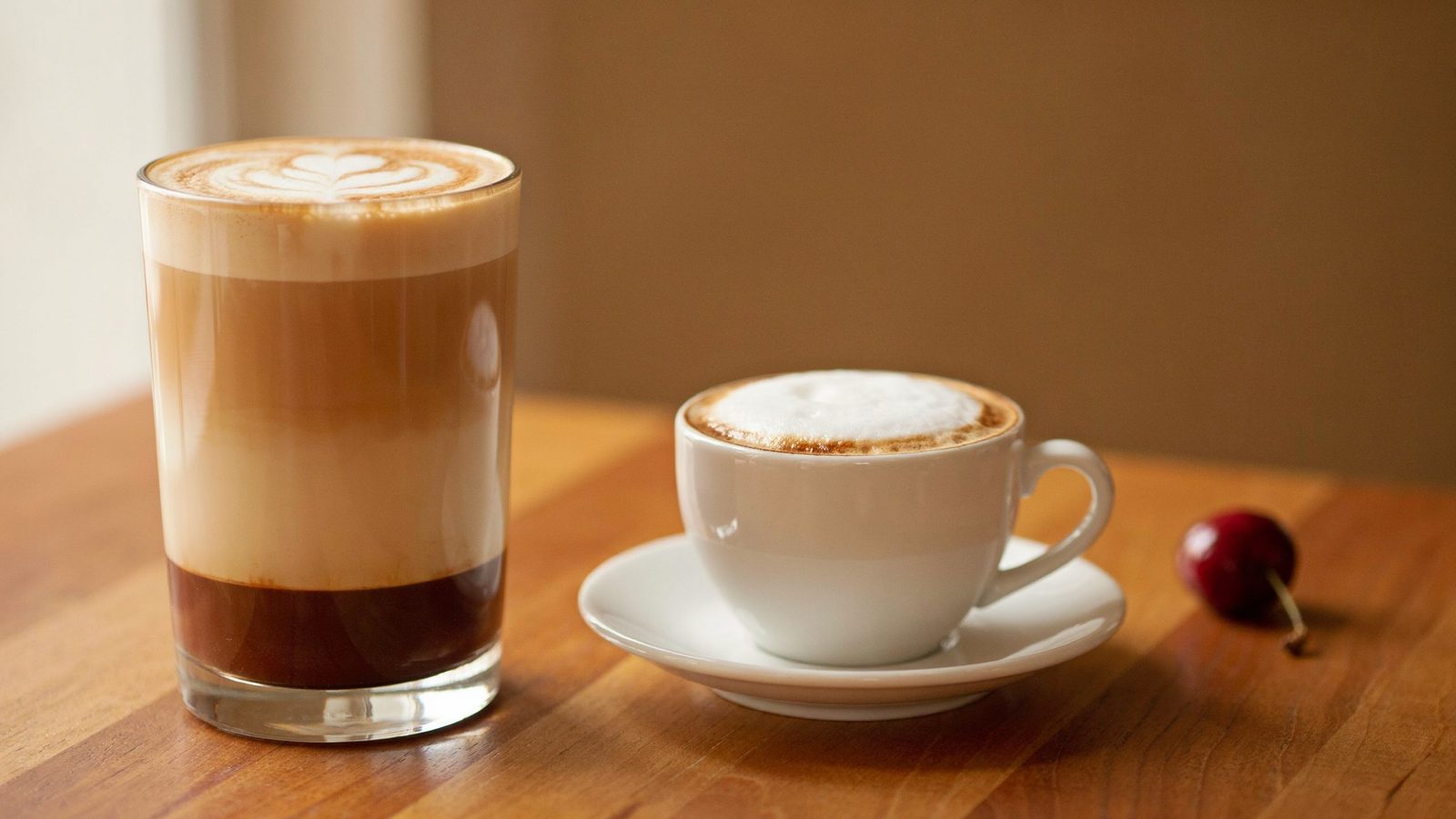
Both drinks start with the same espresso and the same milk. The difference is how much milk goes in, and how much air you whip into it. That one change gives you two very different drinks: a cappuccino that’s small, foamy and coffee-forward, and a latte that’s bigger, smoother and milkier.
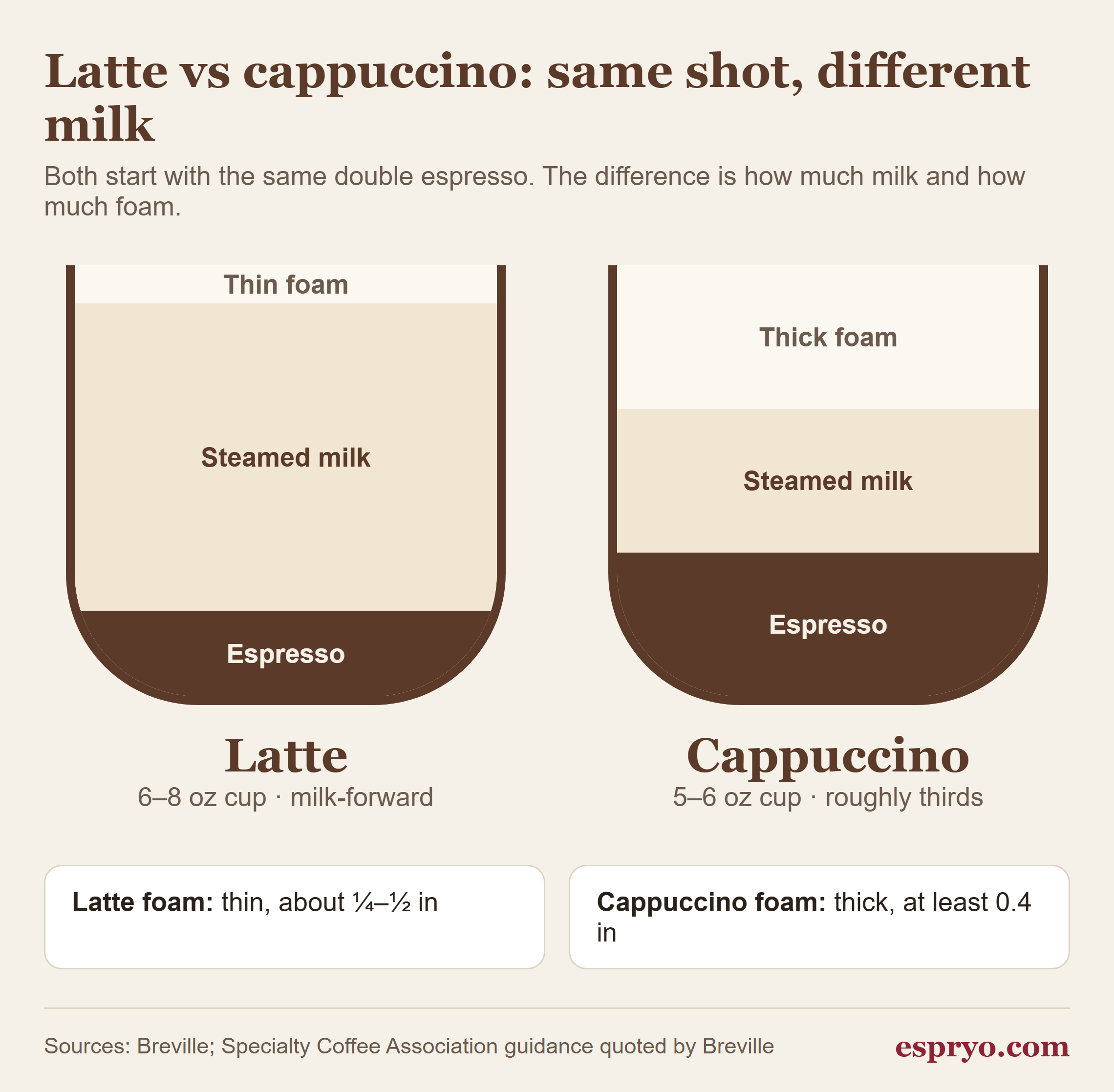
Quick answer: A cappuccino is a small (about 5 to 6 oz) drink of roughly equal parts espresso, steamed milk and thick foam, with at least 0.4 inches of foam on top. A latte uses the same espresso with much more steamed milk and a thin layer of silky microfoam, in a 6 to 8 oz or larger cup. It tastes milder and creamier.
In this guide
Keep · Adjust · Upgrade
| Our verdict | |
|---|---|
| Keep | Use the same shot for both. Breville says a latte and a cappuccino use the same amount of espresso. |
| Adjust | Change the air, not the coffee. Add more air while steaming for a cappuccino, and less for a latte. |
| Upgrade | A pitcher sized to your drink makes the texture far easier to control: a 12 oz for a cappuccino, 20 oz for a big latte. |
The ratio table
| Latte | Cappuccino | |
|---|---|---|
| Espresso | Same as a cappuccino: Breville cites about 36 to 40 g (1.5 oz), a double from 18 to 20 g of coffee | Same. Illy’s single-shot version uses 25 ml of espresso |
| Ratio | About 1 part espresso, 4 or more parts steamed milk, 1 part foam (Breville) | Roughly thirds: espresso, steamed milk and foam (Breville) |
| Foam on top | Thin. Breville’s blog says about 0.2 in; its latte recipe says about ½ in | Thick. At least 0.4 in, per the SCA guidance Breville cites |
| Milk texture | Silky microfoam with little air | Airier, thicker and stiffer foam |
| Cup size | 6 oz to start, 8 oz or larger (Breville) | 5 to 6 oz (SCA, quoted by Breville). Illy describes about 150 ml (5 oz) |
| Milk temperature | About 140–150°F (60–65°C), per Breville | About 131–149°F (55–65°C), per Breville. Illy says about 65°C |
| Taste | Mild, creamy, milk-forward | Stronger coffee flavor, lighter, foamier mouthfeel |
Breville adds that these ratios “may vary depending on where you are in the world,” so treat them as guidelines rather than rules.
The milk is the real difference
How foam is made
Steaming does two jobs at once: it heats the milk and it adds air. Breville explains that microfoam is made by injecting air into the milk while you heat it with a steam wand. Lowering the pitcher so the wand tip sits just under the surface lets the wand pull air in. Once the tip is deeper, the milk spins and heats without adding much more air.
Cappuccino: more air
For a cappuccino, Breville says to increase the air you inject as the milk heats, which makes thicker, more rigid foam. Illy’s home guide describes steaming until the milk roughly doubles in volume. The result sits on top of the drink as a distinct cap that you taste before the coffee.
Latte: less air
For lattes, Breville says to incorporate less air so the microfoam stays small. The milk ends up smooth and pourable, which is also why lattes are the usual canvas for latte art, starting with a simple latte art heart. Breville’s latte recipe suggests focusing on texture first, then temperature.
Which milk?
Lavazza recommends fresh whole milk because it has the right balance of proteins and fats, and says cold milk foams better than warm. Illy says whole milk gives the most velvety foam, while skim milk gives a lighter, meringue-like foam that collapses faster. For plant milks, Lavazza suggests looking for “barista” versions with added protein, and Breville advises not heating non-dairy milk above 130°F (55°C), because it can separate or curdle.
Cup sizes
The cup is part of the recipe, because it sets how much milk goes in.
- Cappuccino: the SCA describes a 5 to 6 oz drink, as quoted by Breville. Breville’s cappuccino guide says a cappuccino is typically 6 oz and suggests an 8 oz cup to leave room for the foam. Illy describes about 150 ml (5 oz). A wide cup spreads the foam more evenly, Breville notes.
- Latte: Breville says lattes start at 6 oz and can be 8 oz, and are typically served in taller cups. Many cafés go bigger; the extra size is milk, not espresso.
If you pour a cappuccino into a big latte mug, you end up with a latte with extra foam. Matching the cup to the drink is the simplest way to get the ratio right.
The Loveramics Egg set on Amazon pairs an 80 ml espresso cup with a 300 ml (about 10 oz) latte cup, so it covers a straight shot and a latte. The listing gives mixed care instructions, so check before using a dishwasher. See our espresso cups guide for more options, and our espresso glasses guide if you like to see the layers.
Where the flat white fits
Breville describes the flat white as close to a latte, with less milk, so the coffee flavor is more concentrated. It’s usually 5 to 6 oz, with about the same thin microfoam as a latte. Think of it as a latte’s texture in a cappuccino’s cup.
How to make each at home
Both drinks follow the same four steps. Only step 3 changes.
- Pull the espresso. Brew a double shot into a warmed cup. Breville suggests about 18 to 20 g of coffee for a milk drink. New to this? Start with our guide to making espresso at home.
- Fill the pitcher. Use fresh, cold milk. Breville says to fill up to the bottom of the spout, because milk expands as you steam it. Lavazza suggests chilling the pitcher first.
- Steam the milk.
– For a cappuccino: purge the wand, then start with the tip just under the surface and keep it there longer, so more air goes in while the milk grows. Illy’s guide steams until the milk roughly doubles. Then lower the tip to spin and heat.
– For a latte: add air for only a few seconds, then lower the tip so the milk spins into silky microfoam. Stop at about 140–150°F (60–65°C), per Breville. - Pour. Tap the pitcher on the counter and swirl it to settle large bubbles, as both Breville and illy suggest. For a cappuccino, pour so the foam piles up on top. For a latte, pour from higher up to start, then lower the pitcher as the cup fills, as Breville describes.
Purge and wipe the steam wand after every drink.
What gear helps
A machine with a steam wand
A wand gives you control over air, which is the whole difference between these two drinks. Our best espresso machine for home guide covers machines with good steam wands. If you want a machine that makes milk drinks at the touch of a button, see our best super-automatic espresso machine guide.
A milk pitcher in the right size
The Rhinowares Professional pitcher is a plain, café-style stainless jug. A 12 oz pitcher is the usual choice for one cappuccino or flat white, and a 20 oz suits a large latte or two drinks at once.
If you’d rather put it in the dishwasher, De’Longhi’s 17 oz (500 ml) frothing pitcher is listed as dishwasher safe on its Amazon listing.
A milk frother (if you have no steam wand)
The Breville Milk Café is a standalone induction frother that comes with two discs: one for latte-style milk and one for cappuccino-style foam. It switches off when the milk reaches the temperature you set. It makes frothed milk rather than barista-grade microfoam for latte art, but it does let you choose between the two textures. Our milk frother guide compares more options.
FAQ
Which is stronger, a latte or a cappuccino?
They usually have the same caffeine, because Breville says both use the same amount of espresso. A cappuccino tastes stronger because it has less milk. Our guide to how much caffeine is in a shot of espresso has the numbers per shot.
Which has more milk, a latte or a cappuccino?
A latte. Breville gives a latte about 4 or more parts milk to 1 part espresso, against roughly equal thirds of espresso, milk and foam in a cappuccino.
Is a cappuccino just a latte with more foam?
Partly. A cappuccino has more foam and less milk overall, in a smaller cup. The SCA, as quoted by Breville, describes it as a 5 to 6 oz drink with a balance of milk and espresso.
What is the ratio for a cappuccino?
Roughly equal thirds: espresso, steamed milk and foam, per Breville. Illy describes a 150 ml cappuccino made with 25 ml of espresso and 85 ml of milk, with the foam making up the rest.
Is a macchiato the same as a latte or cappuccino?
No. A traditional espresso macchiato is espresso with just a dollop of foam. See our explainer on what a macchiato is.